
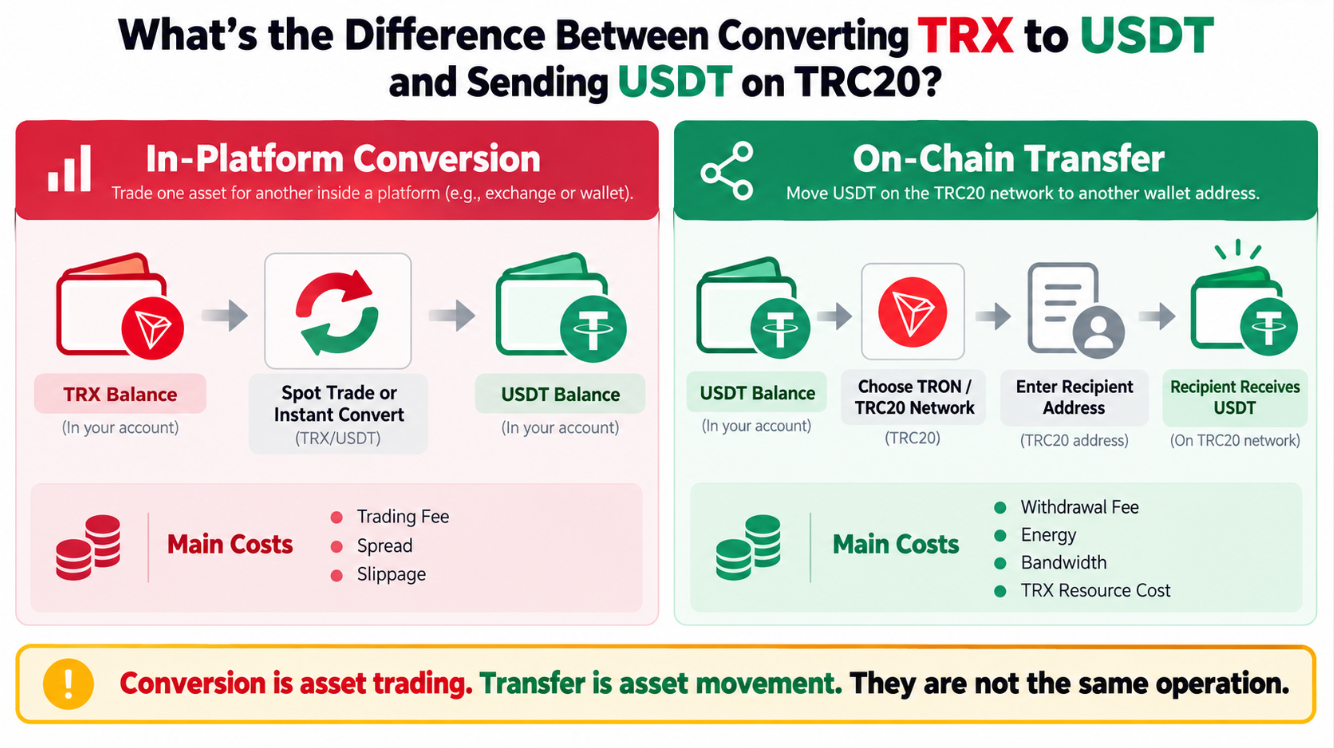
Converting TRX to USDT usually falls into one of two very different scenarios:
- Selling TRX on a trading platform to obtain USDT;
- Transferring TRX or USDT from a wallet to another address via the TRON network.
The first is a "trade," which mainly involves the execution price, spread, and trading fees; the second is an "on-chain transfer," which requires checking the address, network, Energy, Bandwidth, and withdrawal fees. The most common mistake among beginners is conflating these two types of operations and their costs.
If you simply want to reduce your exposure to TRX price volatility, you can usually do so through TRX/USDT spot trading or a quick swap. If you also plan to transfer the resulting USDT to a wallet or another platform, you'll need to complete an additional TRC20 withdrawal.
This article is for educational and risk-disclosure purposes only and does not constitute investment advice. Platform interfaces, fee schedules, regional restrictions, and identity verification requirements may change at any time. Always refer to the platform's live pages before proceeding.
1. What Methods Are There for Converting TRX to USDT? Which One Should Beginners Choose?
Common methods today include spot trading on centralized exchanges, quick swaps, and on-chain swaps within wallets.
1. Quick Swap
A quick swap typically only requires you to select TRX as the pay asset, USDT as the receive asset, enter an amount, and confirm the quote.
Its advantage is the small number of steps: you don't need to understand order books, limit orders, or market depth, making it well suited to first-time users.
Note that "no separate trading fee" doesn't necessarily mean there's no cost at all. Some swap services bake the cost into the bid-ask spread, so what you should really compare is:
How much USDT you ultimately receive for the same amount of TRX handed over.
Quotes are usually valid only for a short window. If you take too long to confirm, the system may ask you to refresh the price.
2. TRX/USDT Spot Trading
Spot trading means selling TRX through the TRX/USDT pair to obtain USDT.
Users can typically choose:
- Market order: sell as quickly as possible at prices currently available on the market;
- Limit order: set your own desired selling price and wait for the market to fill it.
Market orders execute quickly, but during sharp volatility or thin market depth, the final average execution price may be lower than the last price shown before you placed the order. Limit orders let you control your minimum selling price but don't guarantee an immediate fill.
3. Swaps in Wallets or on Decentralized Platforms
If your TRX is held in a personal wallet, you can also use the wallet's built-in swap feature or a decentralized trading service in the TRON ecosystem to convert it to USDT.
Wallet swaps require extra attention to:
- Whether you're accessing an official service;
- Whether the USDT contract is correct;
- Whether the trading pool has sufficient liquidity;
- The estimated receive amount;
- Slippage settings;
- Energy and Bandwidth resources;
- Smart contract authorization risks.
Wallet swaps aren't necessarily cheaper than exchanges, nor are they necessarily better suited to beginners. Judge based on the final quote, on-chain fees, and security risks combined.
How Should Beginners Choose?
If you just want to complete the conversion quickly, start by comparing the final amount received from a quick swap.
If you want to control the execution price, or the amount is large, TRX/USDT spot trading is usually more transparent.
If your assets are already in a personal wallet and you're comfortable with on-chain operations, only then should you consider a wallet swap. For a first attempt, don't submit a large transaction just because a wallet makes swapping look "convenient."
2. What Do TRX, USDT, and TRC20 Mean?
What Is TRX?
TRX is the native asset of the TRON blockchain. It can be used to pay network resource costs, participate in staking, and support various transactions across the TRON ecosystem.
TRX's price changes with market supply and demand, so the same amount of TRX will convert to different amounts of USDT at different times.
What Is USDT?
USDT is a stablecoin issued by Tether, with a market objective of maintaining a value close to 1 US dollar. However, a price-stability objective doesn't mean there's no issuer, market, platform, or short-term depeg risk.
USDT can be deployed on different blockchains. Tether officially lists TRON as one of the supported protocols for USDT, and USDT on TRON uses the TRC20 standard. Official Home of Tether
What's the Difference Between USDT TRC20 and USDT ERC20?
Both are USDT, but they run on different networks:
- USDT TRC20 runs on the TRON network;
- USDT ERC20 runs on the Ethereum network.
Deposit addresses, withdrawal channels, and fee structures for different networks cannot be mixed arbitrarily. Even if a receiving address looks valid, you must confirm that the receiving platform explicitly supports the network you've chosen.
"Same asset name" does not mean "interchangeable transfer networks."
Converting and Transferring Are Not the Same Thing
The path for converting within an exchange is:
TRX account balance → sell TRX → obtain USDT account balance
The path for an on-chain swap in a wallet is:
TRX wallet → call on-chain trading service → obtain USDT TRC20
The path for withdrawing after conversion is:
Exchange USDT balance → select TRON network → withdraw to a TRC20 address
Only the last two paths directly involve TRON on-chain resources or platform withdrawal fees.
3. What Information Should You Check Before Converting?
Check the Live TRX/USDT Market
The amount you receive depends on the actual quote at the time of the operation. You can first check the live TRX market to see the latest price, price change, and market trend.
The last price on a market page is only a market reference. The actual conversion result may also be affected by:
- Price changes between order placement and execution;
- The spread in a quick-swap quote;
- The execution depth of a market order;
- Trading fees;
- Price impact from large orders.
Especially for large conversions, don't just look at the last traded price—check the bid depth as well. A last price of 0.30 USDT doesn't mean all your TRX will execute at 0.30 USDT.
Check Your Account and Trading Conditions
Before you start, at minimum confirm:
- Your account is properly logged in;
- You've completed any required verification per the platform and your region;
- TRX is in available balance, not tied up by orders or other features;
- The platform currently supports TRX/USDT spot trading;
- Deposit, trading, and withdrawal functions are not under maintenance;
- Your region permits use of the relevant services.
Distinguish Three Types of Costs Up Front
The first is trading cost, including spot trading fees or quick-swap spreads.
The second is platform withdrawal fees, which only arise when you transfer USDT out of the platform; the exact amount is shown on the withdrawal confirmation page.
The third is on-chain resource cost, which mainly occurs when a personal wallet initiates a TRC20 transfer or smart contract interaction.
Don't simply add all three together. For example, if you only convert TRX to USDT within the exchange and don't withdraw, you shouldn't add the TRC20 transfer cost of a personal wallet.
4. How to Convert TRX to USDT on HIBT
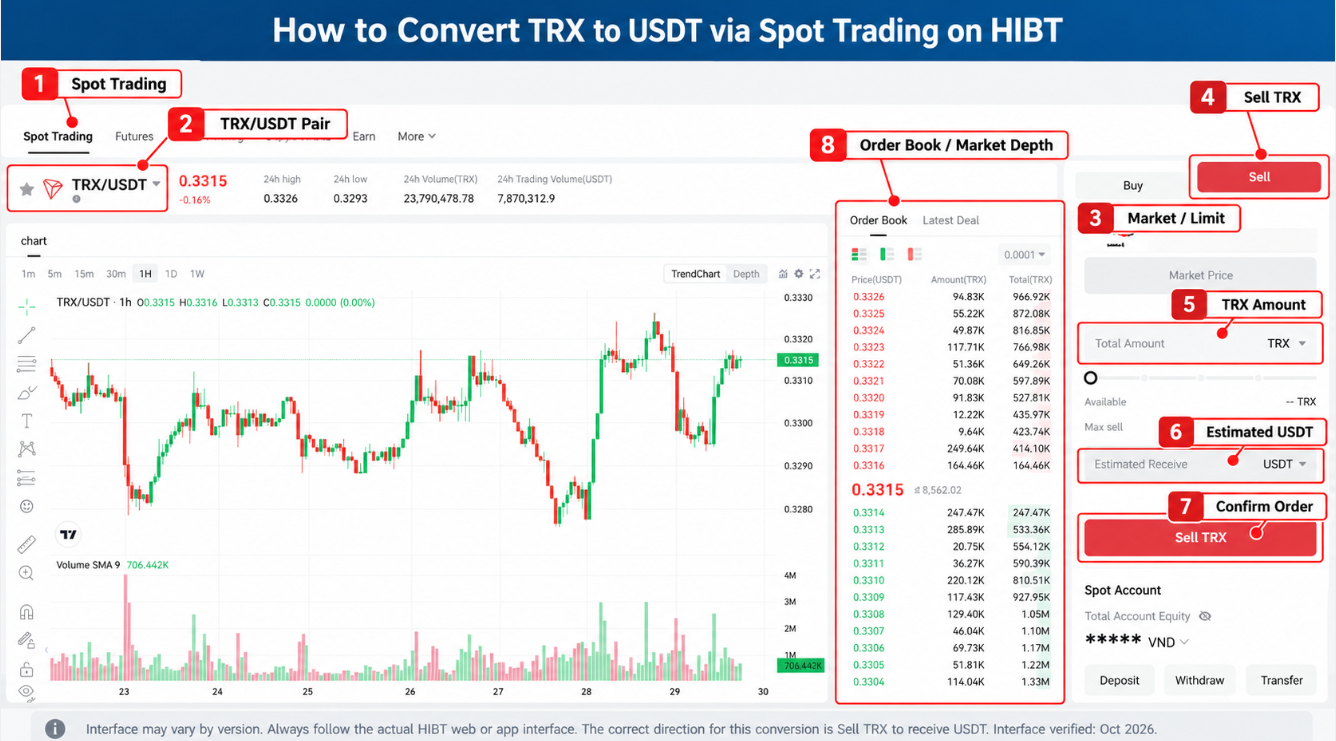
The following uses TRX/USDT spot trading as an example. Entry-point names may differ slightly between the web and app versions; refer to the actual interface.
Step 1: Log In and Check Your TRX Balance
After logging in to HIBT, go to the assets page and confirm your TRX balance has arrived and is in a tradable state.
If your TRX is still in a personal wallet, first go to the HIBT deposit page:
- Select TRX;
- Verify the deposit network shown by the platform;
- Copy the full deposit address;
- Paste the address in your wallet;
- Double-check the beginning and end of the address;
- For large deposits, send a small test amount first.
Don't obtain so-called "exclusive deposit addresses" from chat apps, search ads, or unfamiliar customer service representatives.
Step 2: Find the TRX/USDT Spot Pair
Go to the spot trading page and search for TRX/USDT.
Confirm that the current direction of your operation is:
Sell TRX, receive USDT.
Don't mistakenly select buy TRX, and don't place an order just because "TRX" appears in the search results—verify the full trading pair.
Step 3: Choose a Market or Limit Order
If you choose a market order, enter the amount or percentage of TRX you want to sell, and the system will match against current market bids.
If you choose a limit order, you need to fill in:
- Selling price;
- Selling amount;
- Estimated transaction amount.
After a limit order is submitted, it may remain in "unfilled" or "partially filled" status. Only when the order is fully filled will all the TRX you planned to convert become USDT.
Step 4: Review the Order Before Submitting
Confirm the following:
- You're selling TRX;
- You're buying USDT;
- The amount is correct;
- The order type is correct;
- The limit price has no misplaced decimal point;
- The estimated transaction amount is acceptable;
- The fee shown on the page matches your expectations.
Beginners especially should avoid entering 0.30 as 3.00 or 0.03.
Step 5: Check the Order and Your USDT Balance
After the order completes, go to your order history and check:
- Average execution price;
- Actual filled amount;
- Trading fee;
- USDT ultimately received;
- Whether any portion remains unfilled.
Don't just look at changes in your asset balance. Order details are the primary basis for verifying the actual exchange rate and costs.
5. How Much USDT Can TRX Be Converted To? How to Calculate
If the TRX quote is in USDT/TRX, the basic formula is:
Estimated USDT = TRX amount × TRX execution price
If the platform deducts fees from the proceeds:
Net USDT received = Transaction amount − Actual fees
Assume the TRX quote is 0.30 USDT:
- The pre-conversion value of 100 TRX is 30 USDT;
- The pre-conversion value of 1,000 TRX is 300 USDT;
- The pre-conversion value of 10,000 TRX is 3,000 USDT.
The 0.30 USDT here is only a calculation example; it does not represent the real-time price in 2026, nor does it account for trading fees, spreads, or slippage.
A More Complete Calculation Example
Assume you sell 1,000 TRX at an average execution price of 0.30 USDT:
1,000 × 0.30 = 300 USDT
If the order details show an actual trading fee of 0.3 USDT:
300 − 0.3 = 299.7 USDT
The final figure should be based on the actual amount received shown in the order record. If a quick swap gives a confirmation result of 298.9 USDT, compare 298.9 directly with the estimated net proceeds from spot trading, rather than only looking at whether the quick swap shows "zero fees."
6. What Costs Are Involved in Converting TRX to USDT?
1. Spot Trading Fees
Trading platforms may charge fees based on transaction amount. Rates may differ by account tier, campaign, and trade type, so a single fixed rate shouldn't be treated as a permanent, uniform standard.
Before submitting an order, check the platform's current fee schedule and the order preview.
2. Quick-Swap Spread
A quick swap may not show a separate fee, but the exchange rate it offers may differ from the latest spot market price.
The way to judge whether it's a good deal isn't to look for the word "fee"—it's to enter the same amount of TRX into both methods and compare the estimated USDT received.
3. Slippage and Market Impact
A market order eats through bids on the order book in sequence. If the order is large, later portions may execute at lower prices.
The final average price may be:
Average execution price = USDT actually received ÷ TRX actually sold
For large conversions, consider splitting orders or using limit orders, though splitting doesn't eliminate market volatility risk.
4. Withdrawal Fees
After conversion, if the USDT stays in your HIBT account, there's usually no network fee from an "on-chain transfer."
Only when you withdraw USDT to an external address do you need to check the platform's displayed withdrawal fee, minimum withdrawal amount, and available networks.
5. TRON On-Chain Resource Costs
TRON uses Bandwidth to measure transaction data usage and Energy to measure smart contract computation. Ordinary TRX transfers mainly consume Bandwidth, while TRC20 USDT transfers are contract calls and typically also consume Energy.
TRON's official documentation shows that resources can be obtained through staking or delegation; when resources are insufficient, the network burns TRX to cover the corresponding cost. Relevant on-chain parameters can be adjusted through governance, so a historical fee shouldn't be treated as a permanent standard. developers.tron.network
This is also why a wallet may hold USDT yet be unable to send it due to insufficient TRX or available Energy.
7. What to Watch Out for When Swapping TRX in a Wallet
Confirm the USDT Contract First
The TRON USDT contract address listed officially by Tether is:
TR7NHqjeKQxGTCi8q8ZY4pL8otSzgjLj6t
This address can be verified through Tether's official supported protocols page and TRONSCAN. Official Home of Tether
Don't judge an asset solely by the name "USDT," because anyone can issue tokens with the same or similar names.
Check the Quote and Minimum Received Amount
Before submitting a wallet transaction, check:
- How much TRX you're paying;
- How much USDT you expect to receive;
- The minimum received amount;
- Price impact;
- Service fees or liquidity provider fees;
- Estimated on-chain resource cost.
If the slippage tolerance is set too low, the transaction may fail after the market moves; if set too high, you may get a noticeably worse fill when prices change rapidly or liquidity is thin.
Handle Authorizations Carefully
If a page asks for wallet authorization, confirm:
- The domain is correct;
- The token being authorized is correct;
- The authorization amount is reasonable;
- The contract being called is trustworthy;
- Whether long-term unlimited authorization is truly necessary.
Don't assume a transaction is safe just because your wallet popped up a confirmation window.
8. How to Safely Transfer USDT After Conversion
Confirm the Recipient Supports USDT TRC20
Before selecting the TRON or TRC20 network on the withdrawal page, you must confirm that the receiving wallet or trading platform supports that network.
The safe verification order is:
Asset: USDT → Receiving network: TRON/TRC20 → Full address → Amount to receive
Don't deposit to a platform that doesn't support the TRON network just because TRC20 fees look lower.
Do a Small Test Transfer First
For larger amounts, you can first send a smaller amount permitted by the platform. Once the test arrives, transfer the remaining assets.
A small test adds one withdrawal or on-chain fee, but it reduces the risk of large losses from an address or network selection error.
Save the TxID and Check On-Chain Status
After submitting the transfer, save the transaction hash, also known as the TxID. You can look it up on TRONSCAN to check:
- Whether the transaction succeeded;
- Block confirmation status;
- Sending address;
- Receiving address;
- USDT amount;
- Bandwidth and Energy consumed.
TRONSCAN's transaction details support viewing confirmation status, sending and receiving addresses, resource consumption, and TRC20 transfer records. docs.tronscan.org
"Success on-chain" and "credited to your exchange account" are not the same thing. If the transaction succeeded on-chain but the platform hasn't credited your account, contact the receiving platform's official customer service with the TxID.
9. What to Do If Converting TRX to USDT Fails
Can't Find the TRX/USDT Trading Pair
Possible reasons include:
- You're searching outside the spot market;
- The service isn't supported in your region;
- The platform is temporarily maintaining trading functions;
- The trading pair name or entry point has changed.
Don't immediately deposit assets just because an unfamiliar website offers a trading pair with the same name.
The Order Isn't Filling
A limit order only fills when the market reaches your set price and a counterparty exists. You can check:
- Whether the limit price is far from the current market;
- Whether the order is only partially filled;
- Whether your TRX is still frozen by the open order;
- Whether you need to cancel and resubmit.
The Amount Received Is Less Than Expected
Check the order details for:
- The actual average execution price;
- Fees;
- Filled amount;
- Whether any portion is unfilled;
- The final confirmed quote from a quick swap.
The last price does not equal the average execution price for the whole order.
The Wallet Has USDT but Can't Send It
Common reasons include:
- The wallet doesn't have enough TRX;
- Insufficient available Energy;
- Insufficient Bandwidth;
- The transaction's Fee Limit is set too low;
- The contract call failed;
- The receiving address hasn't been activated, or the wallet service is malfunctioning.
Don't blindly retry repeatedly; first review the failed transaction record and resource consumption.
USDT Hasn't Arrived After a Long Time
Troubleshoot in this order:
- Check the platform withdrawal status;
- Obtain the TxID;
- Check the transaction result on TRONSCAN;
- Verify the receiving address and network;
- Check the receiving platform's confirmation count and crediting requirements;
- If it succeeded on-chain but hasn't been credited, contact official customer service.
Can Funds Be Recovered If I Sent to the Wrong Network or Address?
Not necessarily.
If you sent to a compatible address whose private key you control, there may be technical room to recover; if you sent to a network the receiving platform doesn't support, it depends on whether the platform offers an asset recovery service.
In any case, never give your mnemonic phrase, private key, or wallet verification codes to so-called "recovery experts." Legitimate customer service doesn't need this information either.
10. How to Avoid Swap Scams and Asset Loss
Don't Trust Unusually Favorable Exchange Rates
If the market price is around 0.30 USDT and a stranger promises to exchange at 0.40 USDT, consider scam risk first rather than a so-called "over-the-counter deal."
Legitimate swap services must be able to explain the source of the quote, the execution rules, and how the final amount is received.
Don't Log In Through Unfamiliar Links
Access your account through a verified official website or official app. Search ads, direct messages, group-chat customer service, and counterfeit download pages can all be used to steal accounts or wallet authorizations.
Never Hand Over Your Mnemonic Phrase or Private Key
The mnemonic phrase and private key represent wallet control. Anyone who obtains this information can transfer out the assets in the wallet.
Customer service troubleshooting usually only requires:
- Account UID;
- Order number;
- TxID;
- Deposit or withdrawal address;
- Screenshots of pages that don't contain sensitive information.
Stick to a "Triple Check" for Large Transactions
Before submitting, verify in order:
- Is the asset correct?
- Is the network correct?
- Is the address correct?
After copying an address, also verify the first and last characters to prevent clipboard malware from swapping the address.
11. When Should You Convert TRX to USDT?
Converting TRX to USDT may be for reducing price volatility, preparing for payments, cross-platform transfers, or allocating to other assets—but USDT is not risk-free cash.
Before converting, you can answer four questions in order:
- Why am I converting?
- Do I need to withdraw immediately after converting?
- Can I accept the current exchange rate and costs?
- If TRX subsequently rises or falls, does this decision still fit my original plan?
If you want to research market factors further, you can check the TRX price prediction, but price predictions are only scenario references and cannot replace personal decision-making.
Overall crypto market risk appetite may also affect TRX's short-term performance. You can combine the BTC price prediction and ETH price prediction to understand market scenarios for major assets, but BTC or ETH predictions cannot directly determine TRX's price.
A more rational approach to converting isn't trying to guess the single highest point, but deciding whether to convert all at once or in batches based on your actual use case and risk budget.
12. FAQs on Converting TRX to USDT
Can TRX Be Converted Directly to USDT?
Yes. Platforms that support the TRX/USDT trading pair or quick swaps can convert TRX directly to USDT.
Where Can I Check the TRX-to-USDT Exchange Rate in 2026?
You can check the live TRX/USDT market. The actual result is based on the confirmed quick-swap quote or the actual execution price of a spot order.
How Much USDT Can 100 TRX Be Converted To?
The calculation is "100 × actual execution price." For example, if the quote is 0.30 USDT, the pre-conversion value is 30 USDT, before fees are deducted.
Are There Fees for Converting TRX to USDT?
There may be spot trading fees, quick-swap spreads, or slippage. If you subsequently withdraw USDT, platform withdrawal fees may also apply.
What's the Difference Between Converting TRX to USDT and a USDT TRC20 Transfer?
The former is a trade between two assets; the latter is sending USDT you already hold to another address on the TRON network.
Can I Transfer USDT to Another Exchange After Converting?
Yes, but the receiving platform must support the chosen USDT network and provide a valid deposit address. It's recommended to test with a small amount before large transfers.
Why Does Transferring USDT TRC20 Require TRX?
Because TRC20 transfers are smart contract calls that consume TRON network Energy and Bandwidth; when resources are insufficient, TRX may be burned to cover the cost.
How Long Does It Usually Take to Convert TRX to USDT?
Market orders are usually fast, but limit orders must wait for the price condition to be met. On-chain deposits, withdrawals, and platform crediting times depend on the network and the platform's processing status.
What If USDT Doesn't Arrive After Converting?
First check whether the order was filled. If it's an on-chain transfer, save the TxID, check it on TRONSCAN, and then contact the relevant platform's official customer service.
How Do I Confirm I've Selected the Correct Network?
The network selected by the sender must match the deposit network explicitly supported by the receiver. Don't just verify the asset name—verify the network and address too.
Conclusion: Distinguish Conversion From Transfer First, Then Compare the Final Amount Received
Converting TRX to USDT isn't complicated in itself; what's truly error-prone is confusing networks, fees, and operational scenarios.
When operating within an exchange, focus on checking the TRX/USDT direction, execution price, trading fees, and the final USDT amount received; when operating from a personal wallet, you additionally need to verify the USDT contract, liquidity, slippage, Energy, and Bandwidth.
If you also need to withdraw after converting, re-confirm the TRON/TRC20 network, receiving address, platform withdrawal fees, and actual amount received. For larger amounts, do a small test transfer first and save the order records and TxID.
To judge which method is most cost-effective, don't just look at whether the page says "zero fees." The more reliable standard is always:
Using the same amount of TRX, calculate how much USDT you can ultimately and safely receive after completing all necessary steps.