
STARTUPSI is not just a Solana new coin riding on a name with no product description. After verification, the target asset corresponding to this name is startupSI, deployed on Solana and issued through Pump.fun, with the Mint Address:
EKosQw4oJFbXmeJ4qRnbH1quGFRTc3Eok6nwnFKDpump
The startupSI platform behind it proposes a highly shareable mechanism: a user creates a token, and the platform simultaneously assigns an AI Agent to that token; 90% of the Creator Fee generated by token trading goes into that coin’s Agent budget, while 10% goes to the platform. The Agent then uses the budget to continuously build web tools, games, calculators, or other small products.
But this does not change the core judgment of this article: STARTUPSI should still be viewed as a high-risk speculative asset in the early price-discovery stage, not a mature AI project token with proven long-term value.
The reason is simple. Trading can provide an Agent with a budget, but that does not mean holding STARTUPSI gives you platform revenue, product ownership, profit distribution, or governance rights. Whether the product loop truly exists and whether the STARTUPSI token can capture the value of that loop over the long term are two questions that must be answered separately.
Risk disclaimer: The data in this article is updated as of October 20, 2026. STARTUPSI has been live for only a very short time, and its price, trading volume, liquidity, and holder count may change substantially within hours. This article is intended solely for project research and risk education and does not constitute investment advice or a promise of returns.
8 Things to Know Before Investing in STARTUPSI
- STARTUPSI is a Pump.fun ecosystem token on Solana, not a stock, stablecoin, or traditional startup fund share.
- Its official positioning is not an ordinary meme, but a launchpad that “uses token trading fees to fund AI Agents building products.”
- The target Mint Address is
EKosQw4oJFbXmeJ4qRnbH1quGFRTc3Eok6nwnFKDpump; the ticker alone cannot confirm the asset. - The Pump.fun page labels the asset as an “Unverified coin”; being listed on the platform should not be interpreted as platform endorsement.
- 90% of the Creator Fee goes into the corresponding Agent budget, and 10% goes to the startupSI platform; this is not a dividend to STARTUPSI holders.
- Holders do not own the startup projects, products, revenue, or decision-making rights built by the Agent.
- As of the data snapshot in this article, about 1 billion tokens are counted as circulating by market data platforms, so the main risk is not traditional low-float unlock pressure, but early supply, trading depth, and attention decay.
- My default strategy remains: do not chase the first explosive rally, do not take a large position, do not use leverage, and do not automatically turn short-term profits into long-term conviction.
1. What Exactly Is STARTUPSI? First Separate the Token, the Platform, and the Agent
STARTUPSI has three concepts that are easy to conflate.
- The startupSI platform: a launchpad that allows users to issue tokens and establish an AI Agent for each token.
- The STARTUPSI token: the Solana token corresponding to the platform itself, and the trading asset analyzed in this article.
- Other Agent tokens within the platform: tokens created by users through startupSI, traded on Pump.fun, and separately funding their respective AI Agents.
Understanding these three layers is important. STARTUPSI is not “equity in all AI Agent products,” and other tokens within the platform are not shares in the startup projects built by their Agents. The official FAQ explicitly states that holders own only the token itself and do not own the product, nor do they have rights to fees, revenue, or decision-making.
Therefore, when analyzing STARTUPSI, one cannot directly convert “the Agent built a web product” into “token holders obtained an asset with cash flow.” If there is no clear value-return path between the product and the token, more products will not necessarily increase token value proportionally.
How Is STARTUPSI’s Identity Verified?
Key information that can currently be cross-confirmed includes:
- Network: Solana;
- Issuance and primary trading ecosystem: Pump.fun / PumpSwap;
- Token name: startupSI;
- Ticker: STARTUPSI;
- Mint Address:
EKosQw4oJFbXmeJ4qRnbH1quGFRTc3Eok6nwnFKDpump; - Main PumpSwap pool address:
AscPffyZxMnHHFHqQWawtcrmasgUzCJtwyu6oS6CQD2R; - Official website: startupsi.org;
- Official public account:
@startupsipad.
The target Pump.fun page also displays “Unverified coin” and a high-risk warning. This means that finding the page only proves that the Mint exists and is tradable; it does not prove that Pump.fun has reviewed or guaranteed its business model.
Before buying, at minimum verify in the following order:
Chain → Mint Address → Official website backlink → Main trading pool → Liquidity → Creator and large holders
If any step does not match, you should not proceed to discuss price targets.
2. What Does startupSI Actually Do? It Is Not Just “Issuing Tokens for a Chatbot”
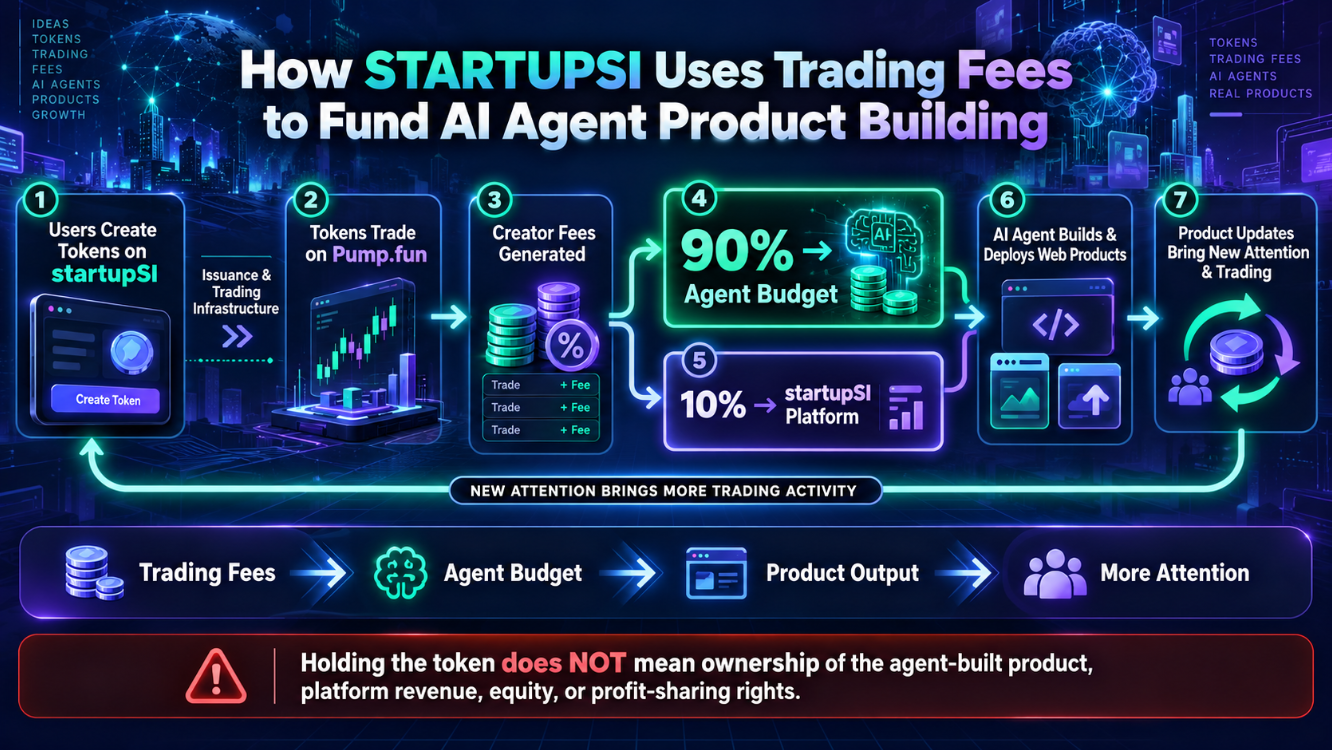
The core narrative of startupSI is: make the trading activity of every token provide a budget for an AI Agent that can keep working.
When a user creates a token on the platform, they can fill in the name, ticker, tagline, and a product brief, or let the Agent choose the project to build on its own. The token is then listed on Pump.fun, and the Creator Fee is distributed according to the ratio locked at creation: 90% goes into that coin’s Agent budget, and 10% goes to the platform.
After reading the brief, the Agent plans the product, writes HTML/CSS/JavaScript, runs checks, and publishes a web product. As long as the budget is sufficient, it can continue starting new work sessions and iterating on the product. The model currently disclosed by the official team is deepseek/deepseek-v4.1-flash, with a typical session cost of about $0.01, and at least 30 minutes between two sessions.
This loop can be summarized as:
Token trading → Creator Fee → Agent budget → Model calls and development → Product updates → New attention and trading
Compared with a pure meme, this mechanism at least adds a layer of observable product activity: where trading fees go, how many times the Agent has run, how much it spent, and what version it deployed can all be verified through the project page and public ledger.
But “observable” does not equal “valuable,” and it certainly does not equal “value belongs to holders.” AI can quickly generate web pages, but that does not mean it has built a sustainable business. Investors must continue asking: Does the product have real users? Does it solve a real need? Will users use it repeatedly? And can STARTUPSI holders obtain verifiable economic benefits from platform expansion?
3. What Is STARTUPSI’s Relationship with Pump.fun? Listing Does Not Equal Endorsement
Pump.fun allows users to create and trade tokens. The official page clearly states that anyone can create a coin, and prices may change rapidly; tokens trade during the bonding curve stage and can enter PumpSwap’s Canonical Pool after meeting migration criteria.
startupSI uses Pump.fun as issuance and trading infrastructure and uses the Creator Fee to provide an Agent budget. Here, three things must be distinguished:
- STARTUPSI is issued through Pump.fun;
- startupSI calls or uses Pump.fun’s Tokenized Agent and fee infrastructure;
- Pump.fun endorses STARTUPSI’s product, price, or future returns.
The first two can currently be confirmed; the third cannot be inferred from them.
Pump.fun’s Tokenized Agent disclaimer is especially worth reading. This feature is essentially an optional automated setting that can execute buybacks and burns according to parameters set by the creator; the setting itself is not AI, nor does it automatically give the token economic value. The related token does not represent any company’s equity, governance rights, profits, dividends, or revenue rights, and buybacks may be modified, interrupted, or fail to raise prices.
Therefore, the most easily exaggerated claim about STARTUPSI is not “it has no product,” but “since the Agent can build products, the token is equivalent to equity in the Agent company.” That inference does not hold.
4. What Does the 90/10 Creator Fee Mechanism Mean?
The fee structure of startupSI is currently the clearest and also the most easily misunderstood part.
When creating a token, the user pays the on-chain cost required by the Solana network, which the official team estimates at about 0.012–0.013 SOL; the platform does not mark up the launch process. Creators can add an optional Boost, and 100% of the Boost goes into the Agent budget.
After the token begins trading, the Creator Fee generated by each trade is distributed as follows:
- 90%: the corresponding token’s Agent budget;
- 10%: the startupSI platform;
- Specific Creator Fee rate: determined by the fee schedule applicable on Pump.fun at the time.
The positive aspect of this mechanism is that there is a verifiable funding link between the Agent budget and market usage. The more trading there is, the more Creator Fees there are, and the more sessions and product iterations the Agent may be able to run.
But it has three key limitations.
First, trading volume is the funding source, but it may also create circular dependence. If the product must rely on token trading heat to continue development, while the product itself has no independent revenue, then a decline in heat will simultaneously depress trading volume, the Agent budget, and iteration speed.
Second, the Agent budget is not income for token holders. The fees are used for model calls and product building and cannot be treated as dividends, buyback promises, or holding yield.
Third, 90/10 is not the entire value-capture mechanism for STARTUPSI itself. It shows that startupSI as a platform can receive a 10% share of Creator Fees, but to judge whether the STARTUPSI token benefits, one must also confirm whether platform revenue is used to buy back the token, whether there are services that must use STARTUPSI, or whether there is other verifiable token demand. Existing public documentation is not yet sufficient to prove that platform revenue automatically flows back to STARTUPSI holders.
5. How Should STARTUPSI’s Tokenomics Be Viewed? A 1 Billion Supply Is Not the Whole Answer
As of the CoinGecko snapshot on October 20, 2026, STARTUPSI had about 1 billion tokens counted as circulating, with circulating market cap and FDV essentially the same. Compared with new coins featuring “low float, high FDV, and continuous future unlocks,” this means its current main supply risk is not multi-year linear release, but rather:
- Early buyers have far lower costs than later buyers;
- The creator or related addresses may hold substantial supply;
- A small number of addresses splitting holdings can obscure actual concentration;
- Liquidity pool size is far smaller than nominal market cap;
- Market price may be moved by relatively limited net buying or net selling.
Market data platforms show that the token’s Mint and Freeze Authority have been disabled, which can reduce some technical risks such as arbitrary minting or account freezing, but it cannot solve price, holding concentration, related wallets, product execution, or market manipulation risks.
Before making a formal trading decision, the following items should be rechecked:
- Total supply and actual circulating supply;
- Top 10 and top 20 address concentration;
- Whether pools, program addresses, and exchange wallets have been excluded from large-holder statistics;
- Net inflows and outflows for creator, developer, and early addresses;
- Signs that the same funding source controls multiple early wallets;
- Whether token and SOL balances in the main pool are persistently declining.
You cannot conclude that “there is no supply risk” simply because FDV and circulating market cap are close. No traditional unlocks does not mean there is no early-holder selling pressure.
6. STARTUPSI Has High Trading Volume, So Why Does That Still Not Prove It Is Worth Buying?
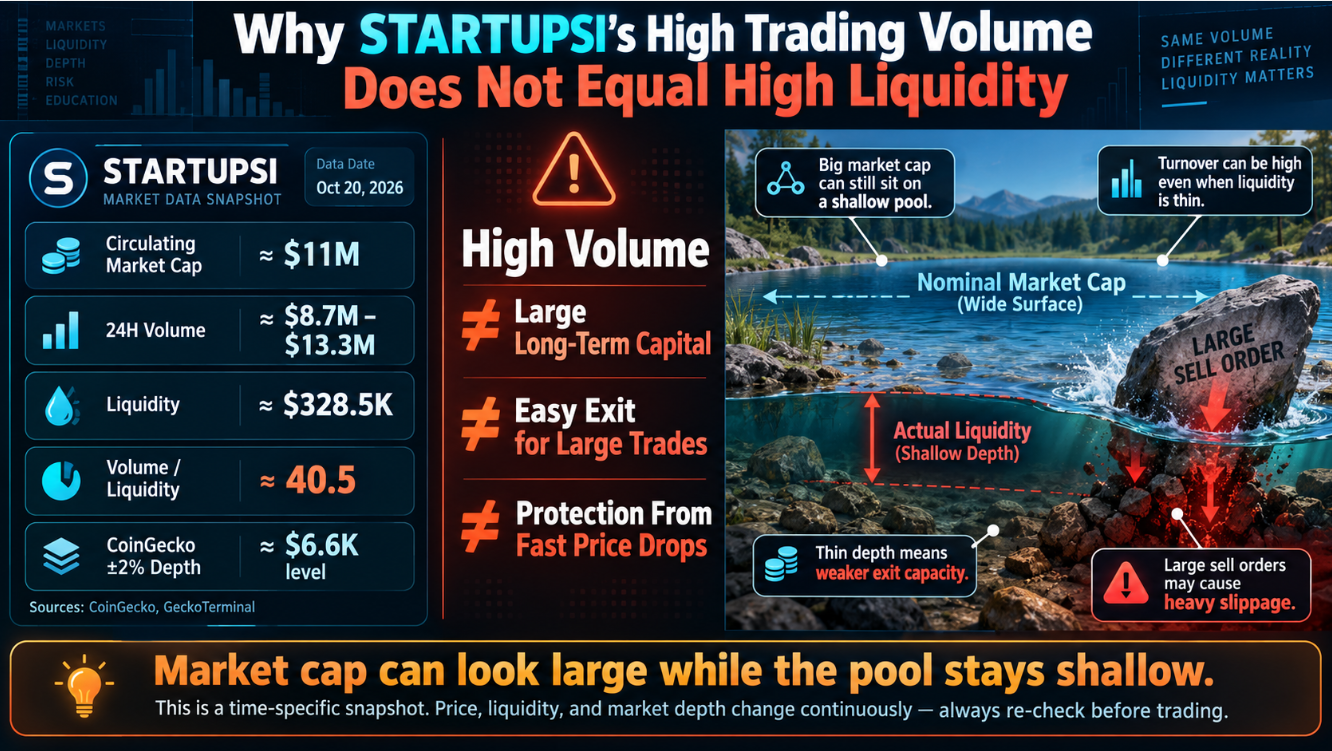
STARTUPSI saw extremely high trading activity during the price-discovery stage after launch. Different data snapshots on the morning of October 20, 2026 showed: price around $0.011, circulating market cap around $11 million, 24-hour trading volume around $8.7 million to $13.3 million, main PumpSwap pool liquidity around $330,000, and about 11,000 holding addresses. Because market conditions change quickly, these numbers can only serve as a research snapshot at a specific point in time.
What deserves the most attention is not any single price, but the relationship among trading volume, liquidity, and market cap.
Using the estimate of $13.3 million in 24-hour trading volume and about $328,500 in pool liquidity:
Volume / Liquidity≈0.3285M/13.3M≈40.5
This represents extremely high turnover intensity, but it does not prove that there is a comparable scale of long-term capital settling in. A large amount of trading may come from high-frequency turnover, bots, arbitrage, or the same batch of capital moving in and out repeatedly.
CoinGecko’s ±2% market depth at the time was around the $6,600 level, meaning that at a certain point, the visible bid-side liquidity sufficient to move the price by 2% was far below the nominal market cap. For users preparing to invest larger amounts, exit capacity is more important than “how big the market cap is.”
Why Are Buy Transaction Counts Much Higher Than Sell Counts, Yet Buy and Sell Amounts Still Close?
The same GeckoTerminal snapshot showed that 24-hour buy transaction counts were far higher than sell transaction counts, but buy and sell amounts were close. This usually indicates that the average sell order size was significantly higher than the average buy order size.
This does not automatically prove market manipulation, but it reminds investors: a large number of small buys can create very strong community buzz and transaction counts, while a small number of larger sell orders can still absorb these buys. When judging capital flow direction, priority should be given to comparing Buy Volume, Sell Volume, and net flow, rather than looking only at transaction counts.
7. What Is STARTUPSI’s Real Upside Logic?
STARTUPSI’s upside logic is not a pure meme, nor is it proven SaaS revenue. It is more like an early experiment in which “product narrative and trading attention reinforce each other.”
Its positive flywheel is:
AI Founder narrative attracts attention → New users trade → Creator Fee increases → Agent receives more budget → More products and updates are released → New content and market attention are generated
For this flywheel to work, at least four checks must be passed.
First, does the platform continue to attract new tokens and users?
It is not enough to look only at how many coins have been created. You also need to see how many Agents actually receive budgets, publish products, and continue updating. A large number of shell tokens that are only created but never traded or built will not form a sustainable network.
Second, do the products built by Agents have users?
Successful deployment only proves that code has been published. More important are unique visitors, repeat usage rate, session duration, user feedback, and whether people are still willing to use the product without token-price stimulation.
Third, does platform growth create demand for the STARTUPSI token?
This is the most easily overlooked step. If growth in the number of platform products, Creator Fees, and Agent sessions does not force users to buy, spend, or hold STARTUPSI, it cannot simply be regarded as token value growth.
Fourth, can the spot market absorb the valuation?
Even if product data improves, the price may already have priced in too much expectation ahead of time. At the same time, observe market cap, pool liquidity, ±2% depth, slippage on large sell orders, and early wallet behavior.
Only when “platform adoption, token demand, and spot-market absorption” improve together does the long-term investment logic become more complete than the short-term narrative.
8. Bull, Base, and Bear Scenarios
Bull Case: Agent Products and Token Demand Form Simultaneously
The optimistic scenario requires:
- Sustained growth in new tokens and active Agents;
- Launched products having real users and repeat usage;
- Creator Fees and Agent spending being publicly verifiable;
- startupSI forming a brand and developer ecosystem distinct from ordinary Pump.fun issuance tools;
- The STARTUPSI token gaining clear, sustained, and not easily substitutable usage demand;
- Spot liquidity and market cap growing together, rather than only price rising.
In this case, the market may reprice STARTUPSI from a short-term new coin into a token for an AI Agent issuance and product experimentation platform.
Base Case: Products Continue to Run, but the Token Mainly Relies on Narrative
The neutral scenario is that the platform continues to create Agents and web products, but most products lack long-term users, and STARTUPSI does not form clear value capture. The token will still swing widely around new products, social buzz, and overall market sentiment.
This is the scenario that deserves more vigilance at present: the product is not fake, but it is not enough to support sustained valuation expansion.
Bear Case: Attention and Agent Budgets Decline Simultaneously
If new buyers decrease, token trading volume will fall; after Creator Fees decline, the Agent budget and product iteration speed will also decline; fewer product updates will in turn weaken content distribution, forming a negativefeedback loop:
Heat declines → Trading decreases → Agent budget falls → Product iteration slows → New attention decreases → Liquidity deteriorates further
For early tokens whose liquidity is far smaller than nominal market cap, this reverse loop may bring drawdowns much faster than those in mainstream assets.
9. Is STARTUPSI Worth Buying? My Judgment Is to Observe First and Not Chase the First Explosive Rally
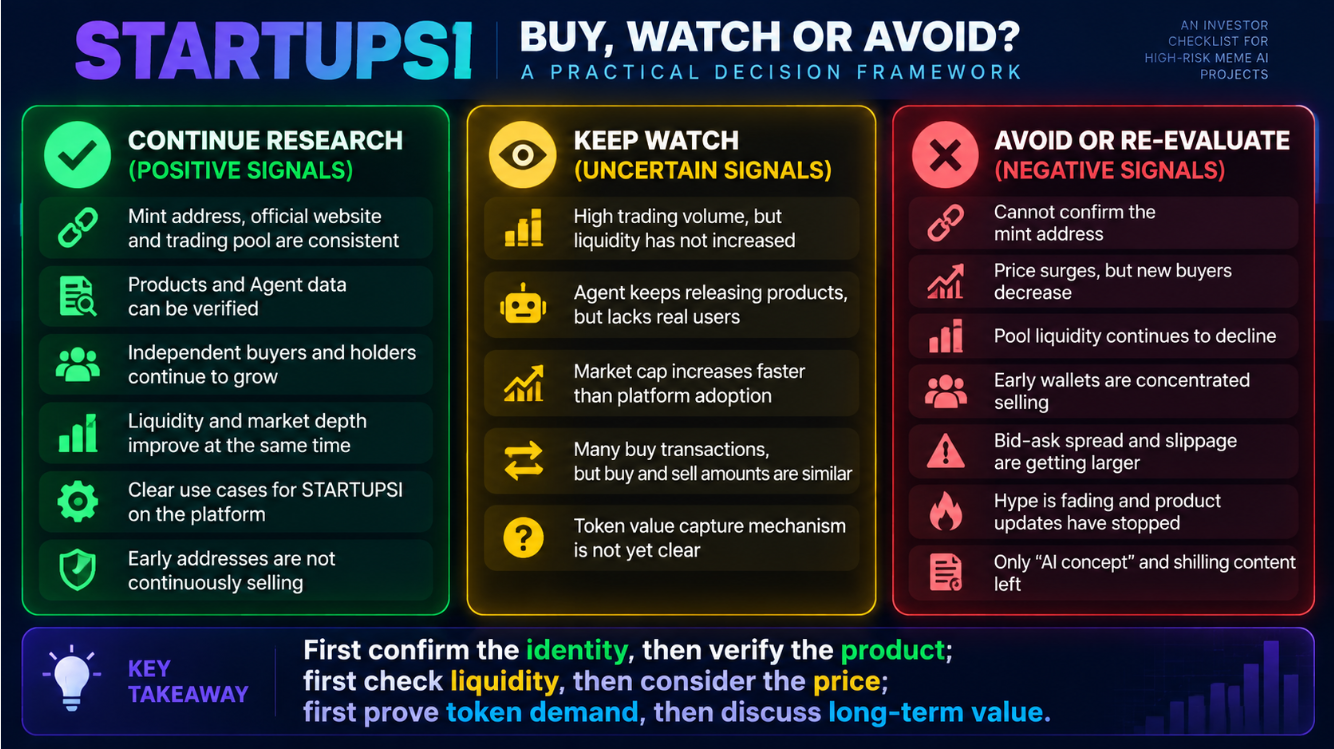
STARTUPSI has a verifiable mechanism beyond a pure meme with no product description, so it is worth researching; but it has been live for too short a time, token value capture is still insufficient, and market price and liquidity are in a stage of violent change.
My decision framework is as follows:

Therefore, I will not classify STARTUPSI as a proven long-term value coin at the current stage. It is more suitable for high-risk investors to study with a small position, not for newcomers to chase based on a single-day gain, and even less suitable for using high leverage to bet on long-term product success.
10. If You Decide to Participate in STARTUPSI, What Strategy Should You Use?
1. Do Not Chase the First Vertical Rally
In the early stage after launch, price is determined by thin depth, short-term capital, and attention together. Waiting for the first round of price discovery before observing liquidity, buy/sell amounts, holder growth, and large-address changes is usually more meaningful than only looking at the gainers list.
2. Size Positions Based on Maximum Acceptable Loss
Position size should not be determined by “how much it might rise,” but by “how much I can afford to lose if liquidity suddenly dries up.”
The following constraint can be used:
Position Size×Extreme Drawdown Percentage≤Maximum Allowable Account Loss
For newly issued tokens with small pool liquidity, the extreme drawdown assumption should be set high enough, and you should even consider the possibility that you cannot exit the entire position at the screen price.
3. Record Trading Logic and Long-Term Logic Separately
If the reason for buying is trading volume, a breakout, or a short-term narrative, the exit conditions should be deterioration in those variables. You cannot wait until the price falls and only then temporarily change the trading reason to “I am bullish on the long-term development of AI Agents.”
4. Set Invalidation Signals in Advance
If any of the following occurs, you should reassess:
- 24-hour trading volume falls rapidly;
- Liquidity pool assets continue to flow out;
- Bid-ask spreads widen and ±2% depth deteriorates;
- New holders and independent buyers stop growing;
- Early or related wallets continue selling into the pool;
- There are many product updates but no evidence of user usage;
- The use case of the STARTUPSI token remains at the narrative level.
11. What Is the Difference Between STARTUPSI and DNA, BORDR, UPRH, and TQQQX?
When seeing a new token, the first step is not to compare which one is rising fastest, but to determine the source of value.
STARTUPSI vs. DNA: AI Agent Narratives Also Have Different Value Chains
DNA live market data and DNA price prediction correspond to NeoSoul DNA, where the main things to verify are AI Agent product adoption, DNA payment demand, and future unlock pressure.
STARTUPSI, by contrast, turns trading Creator Fees into an Agent building budget. Its core question is not traditional team unlocks, but whether platform adoption can translate into STARTUPSI demand, and whether the product loop relies too heavily on trading heat.
Both carry the AI Agent label, but the same valuation formula cannot be used for both.
STARTUPSI vs. BORDR: Trading Heat and Infrastructure Adoption Are Not the Same Thing
What Is BORDR / Bordrless discusses programmable token infrastructure, with key metrics including developer adoption, protocol revenue, trading volume, and buybacks.
STARTUPSI currently relies more on new coin issuance, Agent product narratives, and market attention. BORDR needs to prove that its technology is adopted; STARTUPSI needs to prove that the “trading funds products” loop will not merely produce short-lived web pages and short-lived tokens.
STARTUPSI vs. UPRH: New Narratives Must Return to the Same Verification Sequence
When researching What Is UPRH or STARTUPSI, you should first confirm identity, then check the product, token demand, circulating structure, liquidity, and valuation. Names and sector labels can only help understand the narrative; they cannot replace verifiable data.
STARTUPSI vs. TQQQX: Project Tokens Cannot Be Valued Like Financial Underlying Assets
What Is TQQQX/USDT belongs to another asset category related to exposure to a specific financial underlying; its core is the underlying asset, issuance structure, and tracking error.
STARTUPSI has no external securities net value as a pricing anchor. Its price is mainly determined by product expectations, token supply and demand, liquidity, and market sentiment. Both can be traded, but that does not mean they are the same type of asset.
12. Why Do BTC and ETH Still Affect STARTUPSI?
STARTUPSI’s direct fundamentals come from the startupSI platform and the Solana market, but it still belongs to high-beta crypto assets.
BTC price prediction can be used to observe whether the overall market is in a Risk-On phase. When BTC falls rapidly and the market deleverages, capital usually withdraws first from small-cap, low-liquidity new coins.
ETH price prediction can help observe whether market risk appetite for applications, DeFi, and new narrative assets is broadening. However, BTC or ETH rising will not automatically increase startupSI’s users, nor will it automatically create demand for the STARTUPSI token.
The broad market is only an environmental variable, not proof of project value.
13. The 10 Biggest Risks of STARTUPSI
- Short trading history risk: The historical data is extremely short, and any trend conclusion may be distorted.
- Identity and counterfeit risk: Tokens with the same name may appear; only the full Mint can identify the asset.
- Liquidity risk: Pool liquidity is far smaller than nominal market cap, and large exits may cause significant slippage.
- Supply concentration risk: Early addresses may have a cost advantage far below that of later buyers.
- Volume misinterpretation risk: High turnover does not equal sustained long-term buying.
- Product adoption risk: An Agent can publish web pages, but that does not mean the product gains users or commercial revenue.
- Token value capture risk: Platform growth does not necessarily increase demand for holding STARTUPSI.
- Circular dependency risk: Trading funds development, and a decline in heat may simultaneously weaken the budget and product updates.
- AI and platform execution risk: Model output may be wrong, products may be low quality, or operations may be suspended by the operator.
- Broad market risk: Declines in SOL, BTC, and crypto liquidity may amplify drawdowns.
14. FAQ: The Most Common Questions About STARTUPSI
What is STARTUPSI?
STARTUPSI is the token of the startupSI platform on Solana. The platform allows users to issue tokens on Pump.fun and assigns each token an AI Agent funded by trading Creator Fees to continuously build web products.
Is STARTUPSI an official Pump.fun token?
No. It is issued through Pump.fun and uses related trading and fee infrastructure, but it cannot therefore be called Pump.fun’s official platform coin. The Pump.fun page also labels it as an Unverified coin.
What is STARTUPSI’s contract address?
The Solana Mint Address is:
EKosQw4oJFbXmeJ4qRnbH1quGFRTc3Eok6nwnFKDpump
Before any trade, it should be verified from at least three sources: the official website, the Pump.fun page, and a chain explorer.
Why did STARTUPSI suddenly rise?
The main factors include new-coin price discovery, the narrative of “one AI Founder for every coin,” Pump.fun ecosystem traffic, high-frequency trading, and concentrated short-term capital. The rise itself cannot prove that product adoption or token value capture has matured.
Will 90% of the Creator Fee be distributed to STARTUPSI holders?
No. The official mechanism is that 90% goes into the corresponding coin’s Agent budget and 10% goes to the platform. Holders do not own the Agent product and do not enjoy fees, revenue, or decision-making rights.
How much supply does STARTUPSI have?
As of the data snapshot in this article, CoinGecko calculates market cap and FDV based on about 1 billion tokens in circulation. On-chain supply and statistical methodology should still be re-verified before trading.
What does high STARTUPSI trading volume mean?
It indicates active market trading, but it cannot prove strong long-term buying. It still needs to be analyzed together with liquidity, independent traders, buy/sell amounts, market depth, and large-address behavior.
Is STARTUPSI suitable for long-term holding?
The evidence is currently insufficient. The long-term logic requires the platform to form real product usage and prove that such usage will create sustained demand for the STARTUPSI token. At this stage, it is more suitable to be treated as a high-risk early-stage asset.
Is STARTUPSI worth buying?
My judgment is to observe first and not chase the first explosive rally. Only when identity, product adoption, token demand, and liquidity all improve at the same time is it worth raising the long-term assessment.
Can STARTUPSI go to zero?
Any new token lacking deep liquidity and mature value support has the possibility of extreme drawdown or even going close to zero. The existence of a product cannot eliminate market, supply, and liquidity risks.
15. Conclusion: First Prove the Token Can Capture Product Value, Then Discuss Long-Term Investment
STARTUPSI has a real, observable product mechanism beyond ordinary “issue a coin and it’s over” Pump.fun projects: each coin corresponds to an AI Agent, Creator Fees provide the budget, and the Agent continuously builds and updates web products, with costs and processes publicly viewable.
This makes it worth researching, but it is still not enough to prove that STARTUPSI is worth holding long term.
What truly determines long-term value is not the slogan “AI Founder,” but whether the following chain can be completed:
New users create and trade → Agent receives budget → Products are continuously released → Products gain real users → Platform generates sustainable demand → STARTUPSI token captures value
The first half has currently appeared; the second half still needs verification.
Therefore, my conclusion is clear: STARTUPSI currently has research value and high-risk trading opportunities, but there is not yet enough evidence for it to become a heavily weighted, long-term value asset.
If platform users, active Agents, product repeat usage rates, and actual STARTUPSI demand grow together later, the assessment can be raised again; if trading heat declines, Creator Fees fall, product updates slow, and the token still has no clear value capture, then no matter how novel the AI Agent story is, it cannot replace real demand.
For STARTUPSI, the correct order should be:
First confirm identity, then verify the product; first check liquidity, then consider price; first prove token demand, then discuss long-term value.
Rather than looking for reasons why it must continue to rise simply because the price has already risen.
Sources and Data Notes
- startupSI official website
- startupSI mechanism explanation
- startupSI fees and economic model
- startupSI FAQ
- STARTUPSI Pump.fun page
- Pump.fun Tokenized Agent disclaimer
- CoinGecko STARTUPSI market page
- GeckoTerminal STARTUPSI/SOL pool
Market data updated on October 20, 2026. Because the token has been live for only a very short time, price, trading volume, holder count, pool liquidity, and large-address data should be refreshed again before publication.