
What is NeoSoul DNA? Simply put, NeoSoul is building a product system for "economic AI Agents": AI Agents that don't just provide answers, but can collect information, form judgments, execute tasks within user-defined permissions, and save results for review and subsequent improvement. DNA is the token NeoSoul's ecosystem plans to use for product payments, technical services, internal settlement, and ecosystem incentives.
This direction is worth studying, but my investment judgment won't automatically turn bullish just because of the words "AI Agent."
NeoSoul is worth continued research, but DNA is currently better viewed as a high-risk early-stage product-adoption asset rather than a proven long-term value coin.
What really needs to be verified for investing in DNA isn't whether the AI Agent sector will grow, but three more specific questions: Does NeoSoul's product have real users? Can product usage translate into sustained DNA demand? Can that demand absorb the continuous token supply being released in the future?
If these three questions can't be supported by data, then price increases are more likely driven by listing hype, AI narratives, and short-term capital rather than long-term value being established.
Readers can check the latest price, trading volume, and market performance via DNA real-time quotes, and can also refer to DNA price prediction to understand market expectations. But quotes and model predictions cannot replace research into product adoption, value capture, and unlock pressure.
Risk disclosure: The data in this article was verified as of October 19, 2026, and is intended solely for project research and investment education, not as trading advice. DNA has been listed for a short time, price volatility is high, and circulating supply statistics still vary across platforms. All dynamic data should be re-verified before making decisions.
1. What Are NeoSoul's Core Products? Don't Mistake the AI Agent Vision for Already-Realized Capabilities
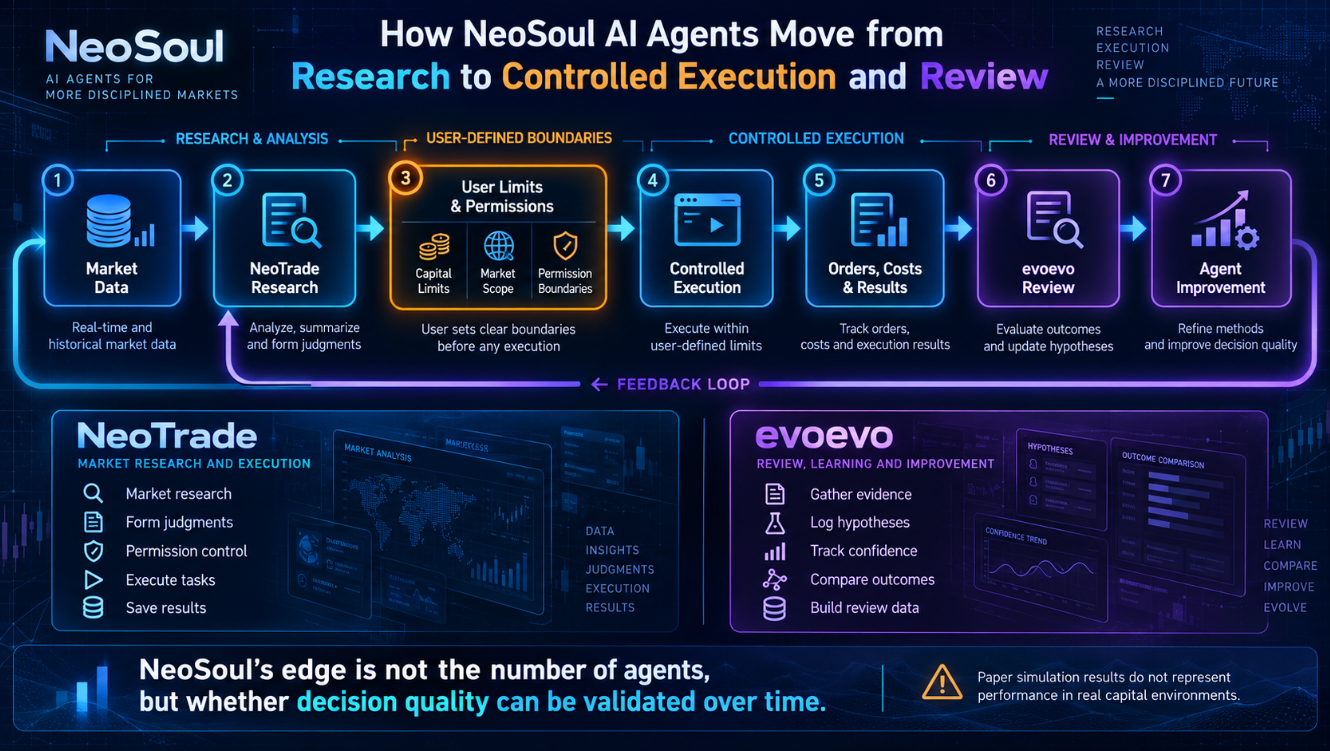
NeoSoul officially describes itself as a "capability production system" for economic Agents, with its core consisting of two products: NeoTrade and evoevo.
The logic behind this design is: real information enters the Agent, the Agent researches, judges, and executes within clear boundaries, results are recorded and enter an evaluation process, and are then used to improve subsequent models, strategies, and operating methods.
This is more worth researching than the narrative of "issuing a token for a chatbot." However, product vision, current capabilities, and future roadmaps must be strictly separated.
What Problem Does NeoTrade Solve?
NeoTrade's official documentation defines it as a local-first trading Agent client for macOS and Windows. Users can set goals, strategies, capital limits, market scope, tool permissions, and risk boundaries; the Agent then researches the market, forms judgments, decides on actions or waits within authorized boundaries, and saves orders, execution results, and exception records.
The currently officially supported environments are:
- Paper simulated trading;
- predict.fun;
- Polymarket.
The Paper environment allows observation of research quality, strategy discipline, and operational stability, but cannot prove that the same results will be achieved in a real-capital environment. Real trading is also affected by liquidity, slippage, latency, fees, order status, and abnormal execution.
Therefore, simulated returns can only serve as early evidence and cannot be directly written as "NeoSoul Agent has proven it can consistently profit."
Why Could evoevo Become a Long-Term Competitive Advantage?
evoevo is not a simple leaderboard showing returns, but NeoSoul's data preparation and evaluation engine. It attempts to organize the complete context of an economic decision, including:
- Sources and timestamps visible at the time;
- Event definitions and settlement criteria;
- Market and task environment;
- Assumptions, confidence levels, and invalidation conditions;
- Predictions, recommendations, or actions proposed by the Agent;
- Trading fees, liquidity impact, and execution anomalies;
- Final results;
- Post-hoc review.
This kind of record is more valuable than "answer correct or incorrect" because a single result cannot explain why the Agent succeeded, nor can it distinguish between capability, luck, and market environment.
If NeoSoul can accumulate enough high-quality economic decision data and use long-term results to verify the Agent's capability boundaries under different conditions, evoevo could form a data feedback advantage. But this still requires real data, repeated evaluation, and cross-cycle performance to prove.
What Stage Has NeoSoul Reached?
The official roadmap divides development into five stages: operational and observable, learnable and evaluable, verifiable and deployable, cross-market generalization, and scaled supply. The current focus is mainly on the first three stages: improving behavior records, building evaluation data, and gradually validating restricted real operations from the Paper environment.
Markets such as meme coins, centralized exchanges, decentralized exchanges, and US equities are subsequent expansion directions and should not be described as already fully launched.
The most important conclusion of this chapter is: A roadmap is not an existing product, and planned expansion is not realized revenue.
2. What Is NeoSoul's Real Competitive Advantage? Is It the Number of Agents or Verifiable Decision-Making Capability?
AI Agent projects can easily showcase "how many Agents were created" or "how many predictions were generated," but quantity does not equal capability.
An Agent that made money in a rising market may have simply been long all along; a single correct prediction may have just been a random hit. Judging whether an Agent has repeatable capability requires answering at least:
- Has it experienced different environments such as rising, falling, and ranging markets?
- Does it account for fees, slippage, latency, and capital occupation?
- Does it disclose maximum drawdown and risk exposure?
- Does it use time-isolated samples to avoid cherry-picking data after the fact?
- Can it reproduce Paper performance in a real environment?
- Can it handle data interruptions, order failures, and extreme market conditions?
How to Judge Whether NeoSoul Is Actually Improving Agent Capability?
I will continuously monitor five types of indicators:
- Prediction accuracy and probability calibration: When the Agent gives a 70% probability, do similar events occur approximately 70% of the time?
- Risk-adjusted performance: Are returns coming from taking on excessive drawdown or tail risk?
- Execution success rate: Can recommendations be completed under real liquidity and order conditions?
- Exception handling capability: Can it stop or degrade gracefully when encountering erroneous data, network failures, and market jumps?
- Evidence of long-term improvement: After review, does the new version continue to improve on independent samples?
NeoSoul's most worthwhile moat to verify is not "how many AI Agents are on the platform," but whether it can continuously prove that these Agents perform better than simple automation scripts, fixed strategies, or general-purpose models.
3. What Are DNA Tokens Actually Used For? What Is Already Clear, and What Still Needs to Wait?
Having a product does not mean the token can capture product value. Analyzing DNA requires separating "officially designed uses," "currently available uses," and "planned rights."
Is DNA Used to Pay for Agent Services, Skills, and Data Services?
According to the DNA official Tokenomics document, NeoTrade plans to use DNA as the sole payment method for product services, covering Agent services, Skills, and data services.
If this design is truly implemented, it could translate product usage into DNA payment demand. However, investors still need to further confirm:
- When paid products will be fully opened;
- The number of users and repeat payment rate;
- How much DNA services are priced in;
- Whether received DNA will be retained, repurchased, burned, or re-enter the market;
- Whether users need to continuously purchase DNA from the secondary market.
Without these data, "DNA can be used for payment" remains only a utility design, not an established value loop.
What Is the Difference for Technical Partners Using DNA?
The official document states that technical partners using DNA for payment can receive a 20% discount, but stablecoins can still be used as a second payment method.
A common misinterpretation must be avoided here: the stablecoin alternative payment corresponds to technical service scenarios; the same document uses the expression "DNA as the sole payment method" for NeoTrade product services. The two scenarios should not be conflated.
If the DNA discount is sufficient to cover holding volatility and transaction costs, partners may actively purchase DNA; if stablecoins are more convenient, DNA demand may fall short of promotional expectations.
Do Ecosystem Rewards Create Demand or Selling Pressure?
DNA is planned for the Agent Developer Program, hackathon incentives, and qualifying Agent Owner rewards. Rewards can attract early developers and users, but freely distributed tokens do not automatically create demand.
What really needs to be observed is: Do rewards bring long-term developers, usable Skills, and sustained paying users, or do recipients sell immediately after receiving tokens? If ecosystem incentive spending increases but product usage and payments do not grow in tandem, rewards are more likely to become supply pressure.
Have Holding or Staking DNA for Premium Rights Been Launched?
No. The official Tokenomics marks holding or staking rights such as higher trading limits and professional data as "coming later," with specific details to be announced at launch.
Therefore, these rights cannot currently be written as existing value, nor can it be assumed in advance that staking will definitely lock up a large amount of supply.
DNA's utility design has some logic, but "the token has uses" and "the token forms sustained net buying" are two different things.
4. How Is DNA Tokenomics Allocated? Which Portions of the 1 Billion Supply Will Affect Price?
DNA has a fixed total supply of 1 billion tokens, officially allocated as follows:

Why Is the 36.175% Ecosystem Share Both an Opportunity and a Risk?
361.75 million ecosystem tokens can support developer incentives, Agent Owner rewards, and ecosystem expansion. If deployed well, it could form a growth loop of "incentives — product supply — user usage — payment demand."
But ecosystem allocation is also the largest potential source of future supply. Investors need to evaluate what each ecosystem expenditure brings: new developers, effective Agents, active users, repeat payments, or merely short-term tasks and selling pressure.
When Do Investors, Team, Treasury, and Advisors Unlock?
These four categories all have 0 unlock at TGE, are first locked for 12 months, then released monthly starting from month 13, continuing for 24 months, and completing by month 36.
Other allocations are different:
- Ecosystem: 20 million unlocked at TGE, locked for 3 months, then released monthly from month 4 to month 39;
- Marketing: 60 million unlocked at TGE, no lock-up, with the remainder released monthly over 12 months;
- Airdrop: 10 million unlocked at TGE, locked for 2 months, then released monthly over 10 months;
- Liquidity: 40 million fully unlocked at TGE.
The entire supply will be fully released by month 39.
5. What Is DNA's Biggest Token Risk? Low Circulating Supply Does Not Equal Low Valuation
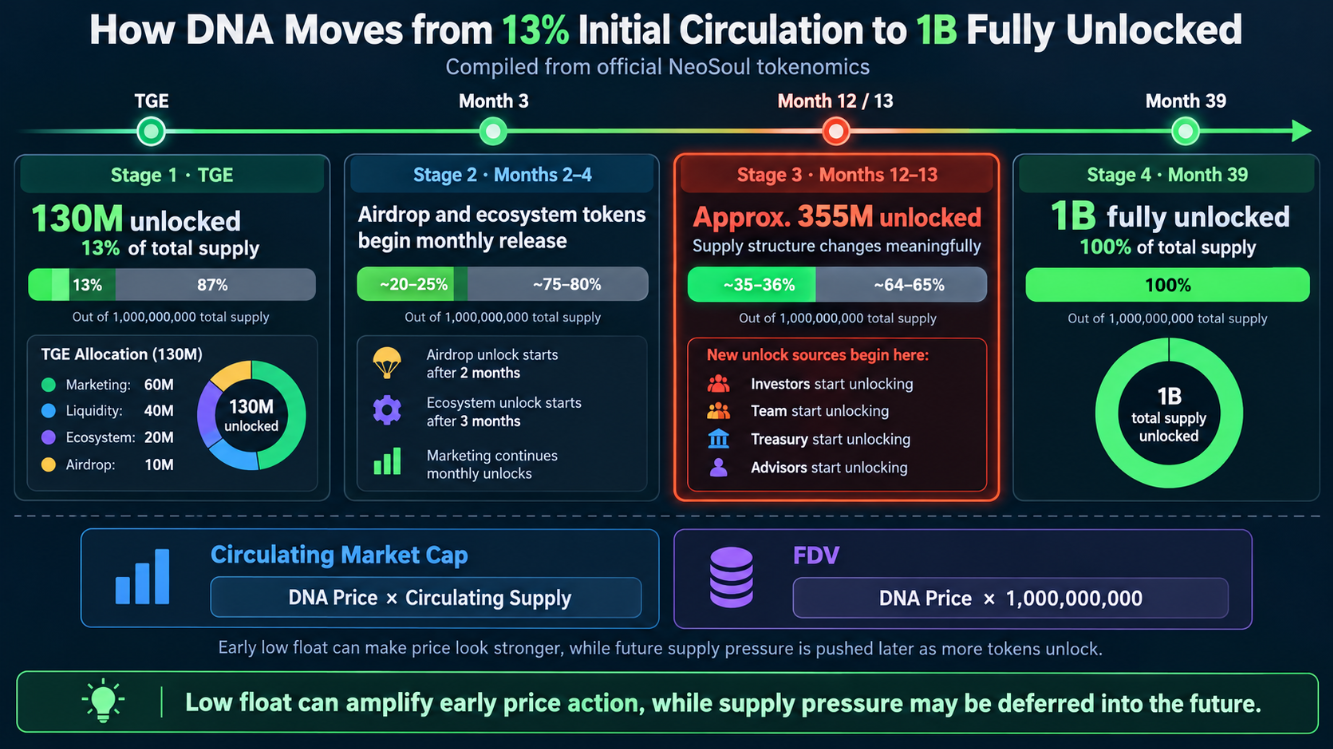
DNA unlocks 130 million tokens at TGE, representing 13% of the fixed total, including:
- Marketing 60 million;
- Liquidity 40 million;
- Ecosystem 20 million;
- Airdrop 10 million.
This means 87% of tokens are still locked at TGE. Low initial circulation can allow relatively small capital to push up the price, and can also create the illusion that "the unit price isn't high and the circulating market cap isn't large, so it's cheap."
Why Must You Look at Both Circulating Market Cap and FDV?
The formulas are:
FDV = DNA price × 1,000,000,000
Circulating market cap = DNA price × current circulating supply
If DNA's price is $0.26, based on CoinGecko's 130 million circulating supply, the circulating market cap is approximately $33.8 million, and FDV is approximately $260 million, with circulating market cap at about 13% of FDV.
This does not mean DNA is necessarily overvalued, but it means the current price already embeds expectations for future product adoption and token demand. As supply increases, the market will need more real capital to maintain the same price.
Can the Market Absorb Approximately 355 Million Tokens Unlocking After One Year?
Officially, cumulative unlocks approximately one year after TGE are expected to be about 355 million tokens, an increase of about 225 million compared to the first day's 130 million, a rise of about 173%.
This does not mean 225 million tokens will definitely be sold simultaneously. Team, investor, ecosystem, and marketing wallets may have different uses, but the increased circulatable supply raises the upper limit of potential selling pressure.
More importantly, after the 12-month lock-up period ends, investors, team, Treasury, and advisors will all enter the monthly unlock phase simultaneously. Investors need to view month 13 as a key inflection point in the supply structure, not just look at a single day's "unlock event."
Low circulating supply is not evidence of undervaluation. It can amplify upside moves, and it can also defer the future demand absorption problem to the unlock phase.
6. Is DNA Trading Heat Real Demand or Early Listing Capital Gaming?
As of the CoinGecko snapshot on October 19, 2026, DNA's price is approximately $0.26, with a market cap of approximately $33.8 million based on 130 million circulating supply, FDV of approximately $260 million, 24-hour trading volume of approximately $73.9 million, and a perpetual contract to spot volume ratio of approximately 5.3x.
These data reflect very active trading, but DNA only entered concentrated trading on October 16, and short-term volume cannot prove that product payments have matured.
Why Doesn't High Volume Prove Long-Term Capital Buying?
Volume can be amplified by the same batch of capital trading repeatedly, and is also affected by market making, arbitrage, listing events, and perpetual contract leverage. Perpetual volume higher than spot usually means price discovery includes more short-term directional trading, rather than all coming from users purchasing DNA for product services.
Market depth also needs to be considered. CoinGecko at the time showed that Gate's DNA/USDT depth within 2% above and below the price was approximately several thousand dollars; major DEX pools had greater depth, but differences between pools were significant. Large positions cannot be assumed to be fully exitabled at the price displayed on the page.
Why Does Circulating Supply Differ Across Platforms?
CoinGecko at the time used 130 million circulating supply, consistent with the official TGE unlock amount; some platforms such as CoinMarketCap once showed 90 million. The difference may come from different treatment of whether marketing, ecosystem, liquidity, or project-controlled addresses are counted as circulating.
Therefore, articles and investment decisions should clearly specify the data basis:
- Official "unlocked" does not necessarily equal third-party recognized "public float";
- Circulating supply displayed on trading platforms may have update delays;
- Market cap must be tied to the circulating supply basis used;
- One should not cherry-pick the number that makes valuation look lowest.
Early listing volume can only prove trading activity, cannot prove NeoTrade usage has grown, and certainly cannot alone prove DNA is undervalued.
7. What Is DNA's Real Upside Logic? It Must Pass Three Verification Gates
I won't list a dozen vague bullish points. DNA's long-term value only needs to pass three gates.
Gate One: Product Adoption
Observe NeoTrade's active users, Agent run counts, repeat usage rate, conversion rate from Paper to restricted real environment, and number of paying customers.
Downloads and registrations only indicate interest in trying; repeat usage and payments are closer to real product demand.
Gate Two: Real DNA Demand
Product usage needs to translate into measurable DNA payments, technical service settlements, or ecosystem collaboration demand. The focus is not "DNA payment is supported," but actual payment volume, number of paying users, token turnover methods, and how product revenue is handled.
If users can use NeoSoul without needing to buy or hold DNA, then product success and token appreciation become disconnected.
Gate Three: Supply-Demand Balance
DNA demand growth must be able to absorb new supply from marketing, airdrops, ecosystem, and team and investor unlocks after month 13.
Only product adoption growth without token demand is insufficient for long-term bullishness; only token trading heat without product adoption likewise cannot prove value. All three gates are indispensable.
8. What Is Most Bullish About NeoSoul? The Real Bull Case
What's truly worth studying about NeoSoul is not that Agents can automatically place orders, but that it attempts to build a complete, observable, and evaluable decision chain:
Research and judgment → execution under user authorization → result recording → post-hoc review → improving the next decision.
If this system can operate continuously, it could accumulate more valuable data than ordinary trading bots: not only knowing the result, but also retaining the basis, assumptions, confidence, execution conditions, and failure reasons at the time.
Under What Conditions Would I Raise My Long-Term Assessment of DNA?
- NeoTrade active users and repeat usage rate grow for multiple consecutive periods;
- The product generates stable, verifiable payment demand;
- DNA forms actual usage in Agent, Skills, and data service payments;
- Agent performance is verified across different markets and over longer periods;
- Real-environment performance does not significantly lag Paper results;
- New supply after unlocks is absorbed by actual demand;
- Spot depth and holder structure gradually improve.
Only when these conditions are met can DNA potentially shift from an "AI narrative asset" to a "product usage-driven asset."
9. Why Won't I Go Long on DNA Solely Based on AI Agent Hype?
Growth in the AI Agent industry does not mean all related tokens will capture value.
Industry returns may be captured by foundation models, compute providers, data companies, application platforms, or enterprises with direct customer relationships. Even if NeoSoul's users grow, it still depends on whether users must purchase DNA and whether DNA payments form long-term demand.
Planned Features Cannot Be Fully Priced In Advance
Holding or staking rights such as higher trading limits and professional data have not yet launched; coverage of meme coins, CEX, DEX, and US equities are also subsequent expansions, not currently fully operational product capabilities.
If development is delayed, it affects not only product progress but also postpones the realization of DNA utility. The market, however, may have already paid a valuation premium for these features in advance.
What Execution Risks Does NeoSoul Still Face?
- Other Agent platforms may offer similar research and execution capabilities;
- User switching costs may not be high;
- Agent long-term performance may not outperform simple strategies;
- Inference, data, infrastructure, and compliance costs may exceed revenue;
- Slippage and anomalies in real trading may undermine Paper performance;
- Users may not be willing to pay continuously;
- Token incentives may attract short-term users rather than real demand.
Being in the right sector cannot replace project execution, and product growth cannot replace token value capture.
10. What Should DNA Price Prediction Focus On? Don't Use Target Prices as a Substitute for Valuation
DNA price prediction can serve as a reference for market expectations and trends, but cannot answer "whether the current price has already priced in future growth."
Fundamental analysis must simultaneously consider:
- Real adoption of NeoTrade and evoevo;
- Product payments and DNA payment volume;
- Circulating market cap and FDV;
- Monthly unlock speed;
- Spot depth and perpetual speculation share;
- Overall market risk appetite.
Three DNA Investment Scenarios
Scenario
Conditions to Observe
My Assessment
Bull Case
Product adoption grows, actual DNA payments increase, Agent performance is verified, new supply is absorbed by demand
Can raise long-term assessment
Base Case
Product gradually develops, but payment scale and token demand remain unclear
Continue to observe, don't chase hype
Bear Case
Product delays, insufficient DNA demand, unlocks increase, spot depth declines
Valuation may remain under pressure
What Signals Would Overturn the Bullish Thesis?
- Active users and repeat usage rate show no growth over the long term;
- DNA payment volume does not increase with product usage;
- Key utility remains stuck on the roadmap;
- New supply outpaces real demand;
- Price increases are mainly driven by perpetual contracts and listing events;
- Agents lack cross-cycle, verifiable performance evidence.
11. Why Does Analyzing DNA Also Require Looking at BTC and ETH?
DNA is a newly listed small-cap AI asset and is very sensitive to overall crypto risk appetite.
BTC price prediction can help judge whether the market is in a risk expansion or contraction phase. When BTC rises and capital is willing to take risk, new AI tokens typically find it easier to gain valuation premiums; when BTC rapidly retraces, newly listed coins with weaker liquidity often suffer larger declines.
ETH price prediction can help observe whether capital is spreading from core assets to on-chain applications and infrastructure.
But BTC and ETH are only market environment indicators, not direct valuation bases for DNA. Even if the broader market rises, it cannot replace scrutiny of NeoSoul's product adoption, DNA demand, and unlock pressure.
12. How Does DNA Differ from BORDR, TQQQX, and UPRH?
The fact that new assets can all be quoted in USDT does not mean the same valuation model can be used.
DNA vs. BORDR: Agent Economy and Token Infrastructure
What Is BORDR / Bordrless mainly studies programmable token standards, developer adoption, protocol revenue, and buyback mechanisms. DNA, by contrast, depends more on AI Agent product usage, service payments, and ecosystem settlement.
BORDR needs to prove that developers are willing to adopt its standard; DNA needs to prove that users are willing to use Agent products and that usage translates into token demand.
DNA vs. TQQQX: Project Token vs. Financial Instrument Exposure
What Is TQQQX/USDT involves another type of asset related to financial benchmark price exposure, whose core analytical objects are the underlying benchmark, tracking mechanism, premium/discount, and issuance structure.
DNA is a project ecosystem token and should be studied through product, revenue, demand, unlocks, and FDV. ETF or equity benchmark net value logic cannot be used to value DNA.
DNA vs. UPRH: How to Compare Two Early-Stage Projects?
What Is UPRH can serve as another early-stage project case. When comparing, one should not just look at which has gained more, but sequentially examine: what problem the product solves, where token demand comes from, current circulating ratio, future supply pressure, and whether trading heat matches real usage.
Identifying the asset type first, then choosing the valuation framework, is the most basic discipline in researching new tokens.
13. If Researching and Trading DNA on HIBT, What Should Be Checked First?
Step One: Verify the Official Contract
DNA's official contract is:
0xA991F61940095AEA0724ef54077223B048c5CF7b
The network is BNB Chain. Do not identify assets solely by the "DNA" ticker, and do not trust so-called official contracts provided via unsolicited private messages.
Step Two: Check Four Data Points Beyond Price
After opening DNA real-time quotes, in addition to price and percentage change, you should also verify:
- Current circulating market cap and FDV;
- Spot trading volume, order book depth, and spread;
- Unlock schedules for the next three months and one year;
- Whether spot and perpetual trading volumes are significantly imbalanced.
Step Three: Establish Trading Discipline
- Don't chase rallies because of the AI concept;
- Don't go all-in based on price predictions;
- Don't use high leverage to bet on long-term product success;
- Determine position size based on maximum allowable loss;
- Before product and token demand are verified, don't upgrade short-term trading into long-term conviction.
HIBT's quote page is suitable for observation and verification and should not be described as proof that DNA will definitely rise or definitely be profitable.
14. When Does DNA Deserve Increased Attention? When Should You Give Up?
Conditions for Increased Attention
- NeoTrade active users and repeat usage rate continue to grow;
- Agent, Skills, and data services generate actual DNA payments;
- Agent performance is supported by long-term, verifiable data;
- The spot market can still absorb new supply after unlocks;
- Liquidity and trading depth gradually improve;
- Launched features continue to be delivered rather than constantly adding roadmap promises.
When I Would Lower My Assessment or Give Up
- Product adoption shows no growth while price remains long-term dependent on hype;
- DNA payment demand has yet to form scale;
- Holding, staking, or premium rights remain stuck in planning stage for a long time;
- Unlock speed significantly exceeds new demand;
- Trading volume is large but spot depth remains insufficient;
- Agent capability cannot be verified through independent samples and real markets.
You don't need to wait until a project completely fails to admit the investment thesis is invalid. As long as key assumptions remain unverified for a long time, there is no need to continue holding solely based on narrative.
15. FAQ: The Most Common Questions About NeoSoul DNA
What Is NeoSoul DNA?
NeoSoul is a product system for economic AI Agents, and DNA is its ecosystem token, planned for product payments, technical services, internal settlement, and ecosystem incentives.
What Is the Difference Between NeoTrade and evoevo?
NeoTrade is a user-controlled trading Agent client responsible for research, judgment, controlled execution, and result recording; evoevo is responsible for organizing economic decision data, evaluating results, and supporting post-hoc review.
What Is DNA's Total Supply?
The fixed total supply is 1 billion tokens, not 100 million.
How Much DNA Circulates at TGE?
Official Tokenomics shows 130 million unlocked at TGE, representing 13% of total supply. Third-party platforms may use different circulating bases, and the source must be specified when using market cap data.
When Will DNA Be Fully Unlocked?
Officially planned to be fully unlocked by month 39. Investors, team, Treasury, and advisors are first locked for 12 months, then released monthly starting from month 13.
How Much DNA Will Unlock After One Year?
Officially, cumulative unlocks approximately one year after TGE are expected to be about 355 million tokens.
What Are DNA's Uses?
Official design includes NeoTrade product service payments, technical partnership services, internal settlement, and ecosystem rewards. Holding or staking for premium product access is a subsequent feature.
Have DNA Holding or Staking Rights Launched?
Official documents mark rights such as higher trading limits and professional data as coming later, and they cannot currently be treated as realized utility.
Can NeoSoul AI Agents Guarantee Profit?
No. Officials also explicitly state that NeoTrade does not promise returns. Paper results cannot guarantee reproduction in real markets.
Why Is DNA's FDV Much Higher Than Its Circulating Market Cap?
Because only part of the tokens are currently in circulation, while FDV is calculated based on the full 1 billion supply. As unlocks progress, the gap will gradually narrow.
How Should DNA Price Prediction Be Viewed?
Price predictions can only reflect model or market expectations. What matters more is NeoTrade adoption, DNA payment volume, unlock speed, spot depth, and the overall market environment.
Is DNA Suitable for Long-Term Holding?
Currently it is better observed as a high-risk early-stage product-adoption asset. Only after product usage, DNA demand, and supply absorption are verified will the long-term thesis strengthen.
What Is DNA's Biggest Investment Risk?
The biggest risk is not the disappearance of the AI Agent industry, but that NeoSoul's product adoption cannot translate into DNA demand while future unlocks continue to increase supply.
16. Final Conclusion: Is DNA Worth Buying?
My judgment is: NeoSoul is worth continued research, but DNA is currently better viewed as a high-risk early-stage product-adoption asset rather than a proven long-term value coin.
NeoTrade and evoevo constitute a product direction worth watching: Agents research, judge, and execute within clear permissions, the system retains evidence, results, and review data, and then uses long-term feedback to improve subsequent capabilities. This is more worth researching than simply packaging an AI concept.
DNA also has a relatively clear design for payments, technical services, internal settlement, and ecosystem incentives. But product development potential does not equal inevitable token appreciation, and planned holding or staking rights cannot be treated in advance as established demand.
The three most important verification points for the DNA investment thesis remain:
- Whether NeoSoul's products are used by real, repeat users;
- Whether product usage translates into measurable DNA purchase and payment demand;
- Whether that demand is sufficient to absorb supply growth from 130 million toward 1 billion.
If these three conditions are gradually met, DNA would deserve a higher long-term investment assessment. If product usage stagnates, token demand is insufficient, and supply continues to be released, then no matter how strong the AI Agent narrative is, it will not be enough to support long-term bullishness.
At this stage, I will not take a heavy long-term position just because listing volume is large, nor will I ignore FDV and unlocks just because the AI Agent sector is hot. The most reasonable strategy for DNA is not to believe in the entire roadmap in advance, but to let product data, payment demand, and supply-demand balance prove the investment thesis item by item.
Data Sources and Update Time
The data in this article is updated as of October 19, 2026. Product and roadmap information mainly references NeoSoul official documentation, NeoTrade documentation, evoevo documentation, and DNA official Tokenomics; market data mainly references CoinGecko. Price, trading volume, circulating supply, market depth, and unlock status are all subject to change and should be refreshed again before formal publication and trading.